
Rain Gauge and Your Garden
How A Rain Gauge Can and Cannot Help Your Garden
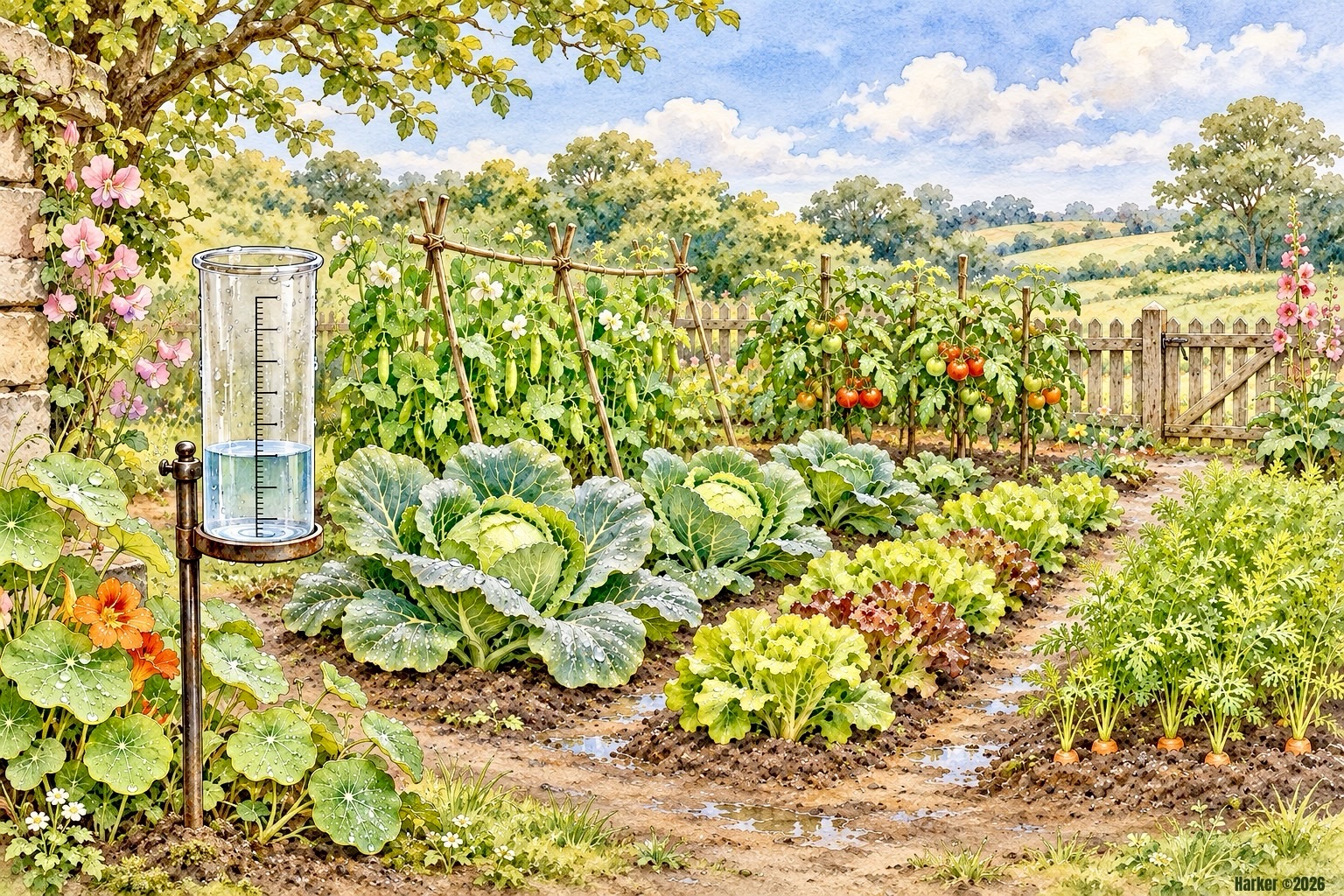
Imagine a gardener studying a rain gauge after a summer storm. At last, a respectable amount of water falls! The gardener relaxes; but too late some plants have already stopped flowering, while others look almost embarrassingly cheerful. Why does the same weather produce such different responses, and what would it actually mean for this garden to withstand a drought?
We often describe a planting as “drought-tolerant”. Yet surviving, flowering, producing vegetation, and retaining a diverse community are different achievements for plants. Recent grassland research helps separate those questions.
 Rain Wish incarnation I want to be the rain – to quench the thirst of all the mouths of all the creatures on the land and fill the roots of plants. Rain that cleans the air ©2026 Carl Scott Harker, author of 
HEALING THE LAND: |
Growing-season rainfall relative to the atmosphere’s drying power best explained year-to-year variation in aboveground plant production. Reduced rainfall, especially in summer, altered the community. Interestingly, delivering rain less frequently caused no overall production change, but plant diversity declined. A landscape could therefore maintain its output of vegetation while losing variety.
What about planting more species? A July 15 synthesis in “Nature Ecology & Evolution” combined 75 biodiversity experiments in grasslands and forests. Researchers compared mixtures with single-species plots to examine how diversity’s effect on productivity varied with climatic extremes and background conditions.
Diversity helped productivity most during extreme drought in the drier grasslands studied. Results pointed to benefits from species complementing one another, rather than merely including an exceptional producer. Forest evidence was thinner, and the driest grasslands and several regions were poorly represented. The study does not show that diversity’s benefit keeps increasing as conditions become drier – some minimum amount of water is necessary to keep the total plants alive.
For prairie restoration, I take this as encouragement to consider diversity alongside site conditions and explicit goals. Producing vegetation, retaining characteristic species, and supporting wildlife are distinct outcomes.
Even deciding which plant features to measure can change the story. A study published October 16 in the “Journal of Ecology” used a four-year rainfall experiment in semi-arid grassland near Boulder, Colorado. Researchers measured nine leaf, root, and whole-plant traits and compared different ways of describing the community’s functional diversity – the variety of plant characteristics and strategies present.
Some conclusions about drought responses and the stability of plant biomass depended on which traits and mathematical measures were selected. This is a reminder to determine what “resilient” means in any particular claim. A nursery label, a restoration report, and a research paper may be answering different questions. The study tested ecological measurements, not a universal list of the best garden plants.
For the home gardener, the first useful response is wonderfully ordinary: get to know the site before filling the cart. Colorado State University’s Landscape for Life guidance on native plants emphasizes matching plants to soil, light, and moisture conditions. Native plants come from wet places as well as dry ones. A species can belong to your region and still be poorly suited to the hottest, driest corner of your yard. “Native” describes a relationship to place; it is not a promise of indestructibility.
Make a modest site map. Mark the exposed slope, the afternoon shade, and the patch that stays damp after rain. Use those observations when consulting a local extension service or native-plant nursery. For a prairie-inspired border, choose locally appropriate grasses and flowering plants that share the conditions you can provide. Treating a dry bed and a damp hollow differently can make more sense than trying to persuade both to grow the same attractive collection.
Next, distinguish an established planting from a newly planted one. CSU’s water-wise landscaping guidance notes that watering needs depend on soil, vegetation, establishment, season, and weather. It recommends using rainfall information alongside soil-moisture observations and knowledge of the plants. New plants have not yet developed the root systems of established specimens. Planning support during establishment is part of creating a planting that can eventually need less intervention.
The same guide recommends checking irrigation equipment and adjusting schedules as conditions change. That is an achievable autumn job: look for leaks, misplaced spray, and settings left over from summer. A timer is an excellent servant, but it has no idea that you replaced a thirsty annual bed with established shrubs unless someone tells it. Record what you change, so next season’s watering decisions begin with something better than a vague recollection.
Mulch offers another practical tool, where it suits the planting. CSU’s mulching guidance explains that a surface covering can reduce evaporation, moderate soil temperature, and suppress competing weeds. It also stresses keeping organic mulch away from plant bases and avoiding excessive wetness around vulnerable seedlings. Choose the material and application for the plants and setting. This is guidance for managing garden beds.

There is also a useful experiment that requires no experimental drought to improve your record keeping. Choose a small border and photograph it from the same position through the growing season. Note rain, supplemental watering, flowering, and visible stress. Record what returns the following spring. Keep survival and flowering in separate columns, because a living plant and a flowering plant provide different information – a plant might survive, but not flower.
Which plants flowered through the dry spell? Which paused and resumed? Which were accidentally receiving water from a nearby sprinkler? That last question is especially valuable. An apparently heroic plant may have had help! A family notebook can be a true learning how to make your garden grow experiment.
A rain gauge is useful equipment, but does not provide all the answers to how your garden is going. Add knowledge of the plants, attention to the soil, and a record of what happens through time. The result is a more interesting garden – and a clearer understanding of what you are asking it to survive, sustain, and become.
_______________
Sources:
– Boettiger et al., “What we measure matters: Trait choice shapes inferences about grassland functional diversity under altered precipitation.” “Journal of Ecology”, October 16, 2026.
– “A Decade of Rainfall Manipulation Reveals Growing-Season Aridity as a Key Determinant of Grassland Productivity and Stability.” “Global Change Biology”, August 26, 2026. Author-institution abstract.
– “Biodiversity effects under climate extremes intensify with aridity in grasslands but not forests.”Native and Adapted Plants, Water-Thrifty Sustainable Landscapes, and Mulch. Practical guidance, accessed October 30, 2026.
Comments
Rain Gauge and Your Garden — No Comments
HTML tags allowed in your comment: <a href="" title=""> <abbr title=""> <acronym title=""> <b> <blockquote cite=""> <cite> <code> <del datetime=""> <em> <i> <q cite=""> <s> <strike> <strong>