
Garden Buzzing – Biodiversity Slipping Away
When a Garden Is Buzzing – but Biodiversity Is Quietly Slipping Away
“New research shows why a lively-looking landscape can still be losing its most vulnerable pollinators – and what gardeners and prairie restorers can do about it.”
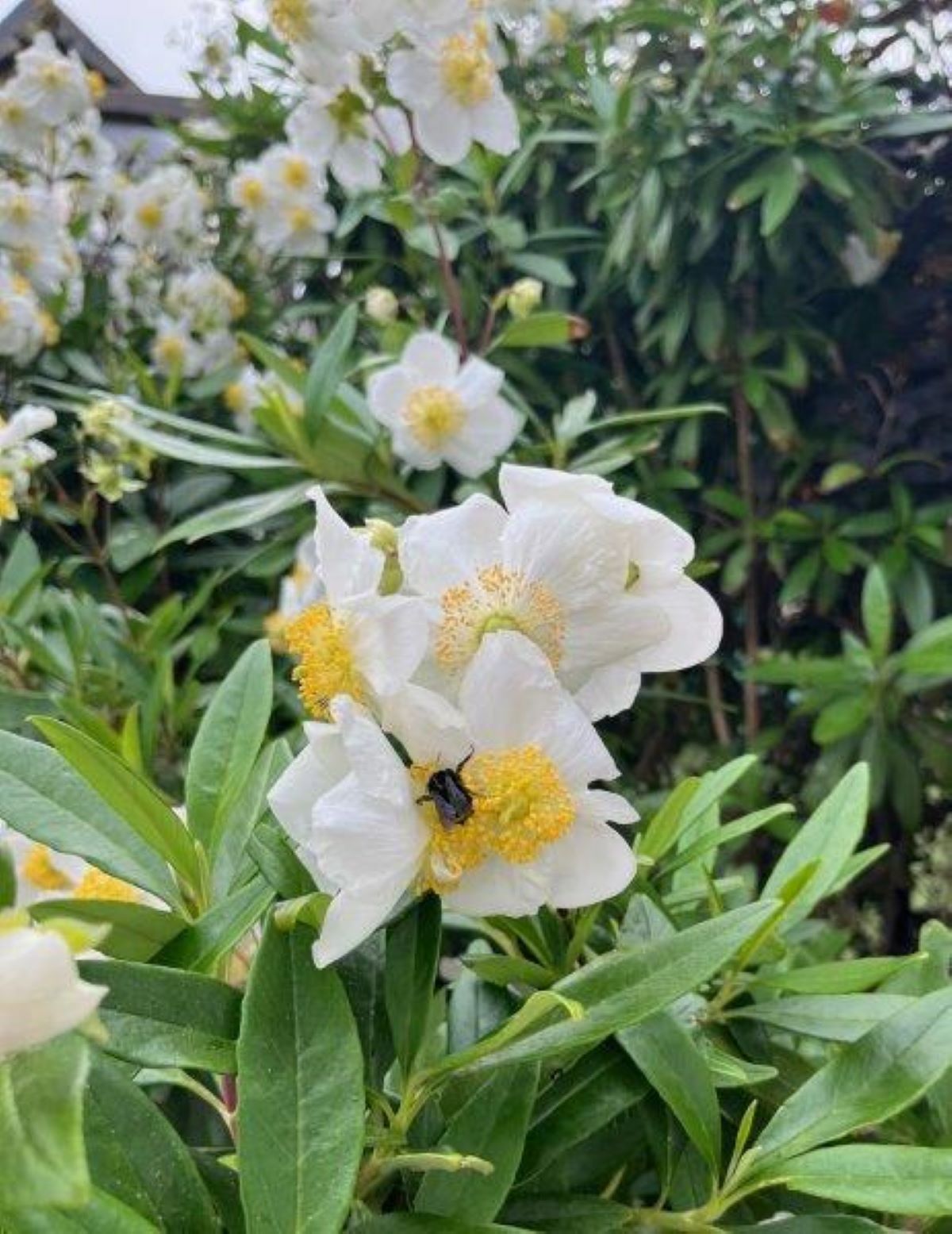
Bee visiting bush anemone (*Carpenteria californica*) in a California front yard. • Stephen Curry/USFWS. June 1, 2024.
Is this your situation: Bees are humming around a large lavender bush. Honey bees crowd the flower spikes; a bumble bee barges through now and then. It looks like a conservation success. But is the garden supporting many kinds of pollinators, or merely serving a great many individuals from two adaptable species?
That distinction sits at the heart of a major new study published in “Proceedings of the National Academy of Sciences” on October 19, 2026. One of the lessons from the study is: “A place can retain the same total number of species while losing some of its original species and gaining others. Because different species interact with their surroundings differently, an unchanged total can conceal important ecological changes.” Rare species maybe replaced by more common species, suggesting a total decline in the total number of individual species in the overall environment, ie, less biodiversity in totality.
A century of dots on the map
Carlos Martínez-Núñez and an international research team assembled more than four million occurrence records of wild bees and hoverflies collected across Europe from 1921 through 2020. Together, those dots on the map covered about 88 percent of Europe’s known bee and hoverfly species.
The researchers asked three related questions. Were species still being recorded in the modern period? Had the number of species in broad European regions changed? And had each species’ “occupancy” – the probability that it would be recorded in a particular area—expanded or contracted?
The broadest answer looked reassuring. Most species recorded historically were still found somewhere in Europe in 2001–2020. Regional species totals also changed less than many people might expect. Richness declined persistently in the Atlantic and Continental regions for both groups, while bee richness recently increased in the Alpine region and was comparatively stable in several other regions.
Then the researchers looked at individual species. Most bee species and about half of hoverfly species had declining occupancy trends. While many had not vanished from Europe, they were turning up in fewer places. Critically endangered bees showed especially steep declines. Cold-adapted bees tended to fare worse than warm-adapted ones, although that relationship was weak, and ecological traits generally explained surprisingly little of the variation.
This is not a story of a continent suddenly emptied of bees. It is a story of contraction: species holding on, but across smaller portions of their former ranges.
The problem with a simple head count
Suppose a meadow loses three sensitive bee species but gains three common, flexible ones. Its species count has not changed. On a clipboard, that line can look stable. Ecologically, however, the community may have become more uniform and less able to perform the full range of pollination jobs.
The new study did not measure pollination itself, so it cannot tell us how much ecological function has already been lost. It does show why totals alone are a poor early-warning system. Which species remain, how widespread they are, and what relationships they have with plants all matter. Plants that have fewer pollinators will beging to, literally, lose ground.
Oregon State University researchers found a garden-scale version of this measurement trap in a three-year trial of flowering plants. Lavender attracted plenty of bees, but most were nonnative honey bees or the common yellow-faced bumble bee. Several native plants attracted a broader collection of wild bees; Douglas’ aster, for example, was estimated to support 74 species. The point is not that lavender is “bad.” It is that one popular plant can generate an impressive amount of buzzing while leaving many less common bees unserved.
There is a hopeful companion anecdote. In an OSU survey of 24 Portland-area gardens, one tiny garden beside Interstate 5 had the second-highest bee abundance and likely ranked first or second in diversity. A small garden cannot repair a continental decline, but intentional planting can make a surprisingly useful patch of habitat!
What this means for prairie or other types of restoration?
The European analysis was not a prairie study, applying its result to North American grasslands or other landscapes must be done byinference. Still, it offers prairie restoration a valuable question: are we restoring a high total of flowers and insects, or are we restoring the particular relationships that make a prairie a prairie?
A restored site can look spectacular when a few robust wildflowers bloom in great swaths. Successful measures should also ask whether indigenous plants are establishing, whether specialist or declining insects are returning, and whether species these occupy more of the site over time. In a fragmented landscape, protecting remnant prairie and linking it to restored patches is especially important because a garden or seed mix cannot substitute for every soil, nesting, and host-plant relationship in an old grassland.
Garden for the quiet visitors

First, build a bloom calendar instead of a shopping list. Aim for overlapping flowers from early spring into fall, including locally native annuals, perennials, shrubs, and small trees. In western Oregon, OSU’s research-backed examples include globe gilia and farewell-to-spring, Oregon sunshine and rose checkermallow, then Douglas’ aster and goldenrod later in the season. Elsewhere, use your state extension service, botanic garden, or native plant society to choose plants genuinely native to your eco-region. Do not dig plants from the wild.
Second, plant variety with purpose. Combine different flower shapes, heights, and bloom times, and repeat each species in a visible patch rather than scattering lone plants. Include plants known to have close relationships with local bees where that information exists. A generalist bee may use dozens of flowers; a pollen specialist may depend on one plant family or genus. The plant that attracts the greatest crowd is not necessarily the plant that expands the guest list.
Third, provide bedrooms as well as breakfast. Many native bees nest in undisturbed soil; others use hollow or pithy stems and cavities in wood. Leave a few small patches of bare, untilled ground, retain some standing stems through winter where safe, and tolerate a little leaf litter and woody material. Avoid broad-spectrum insecticides. If a pest problem truly requires treatment, identify it first and ask an extension expert for the most targeted approach and timing.
Finally, observe differently. Once a week in bloom season, spend ten minutes at the same patch. Note not only how many insects arrive, but how many visibly different kinds you see, which flowers they use, and when they appear. Photographs uploaded to a vetted community-science project or local bee atlas can become more useful than memory alone. This is not a formal population survey, and photographs may miss tiny or difficult species, but it trains the eye to notice whether a garden’s apparent abundance comes from many kinds of visitors or a resilient few.
What the study cannot tell us
Historical occurrence data are powerful and imperfect. Collectors visited some places and species more often than others; records are thinner in parts of southern and eastern Europe; and newly described hoverflies have little historical paper trail. Statistical models can reduce those biases, not erase them. Occupancy is also not the same as abundance: a species recorded in a map cell may be flourishing there or hanging on by a thread. Finally, this observational study describes trends; it does not prove which combination of habitat loss, pesticides, agricultural intensification, or climate change caused each one.
Nor should European results be used as a status report for North American bees. Their broader message travels better than their exact numbers: extinctions are a late alarm. Shrinking ranges, disappearing specialists, and communities increasingly dominated by adaptable species warn us sooner.
Many species still persist, although they maybe struggling. There is time to protect remnants, restore diverse habitat, improve monitoring, reduce pesticide exposure, and make farms and towns more flower-rich. The useful question for a gardener is no longer just, “How many bees are here?” It is, “Who is here – and who might still be missing?” Then plant accordingly.
## Sources
– Martínez-Núñez, C., et al.Historical trends show more declining than increasing species among European pollinators – Proceedings of the National Academy of Sciences 123(44), e2600774123. Published October 19, 2026.
– Estación Biológica de Doñana–CSIC. “A century of data reveals widespread declines in wild pollinators across Europe” – Published October 19, 2026.
– Oregon State University Extension. “Native Plant Picks for Bees: 10 Species You Can Grow to Support Wild Bees in Oregon.” – Peer-reviewed extension publication based on 2017–2019 field research.
– Oregon State University Extension. “Native bees in Oregon deserve the spotlighthttps://extension.oregonstate.edu/news/native-bees-oregon-deserve-spotlight.” – Reviewed 2025.
– Oregon State University Extension. “Shrubs and Trees for Bees.” Peer-reviewed extension guidance.
Comments
Garden Buzzing – Biodiversity Slipping Away — No Comments
HTML tags allowed in your comment: <a href="" title=""> <abbr title=""> <acronym title=""> <b> <blockquote cite=""> <cite> <code> <del datetime=""> <em> <i> <q cite=""> <s> <strike> <strong>