
Compost: How Much Does Your Garden Need?
Compost Is Wonderful. How Much Does Your Garden Need?
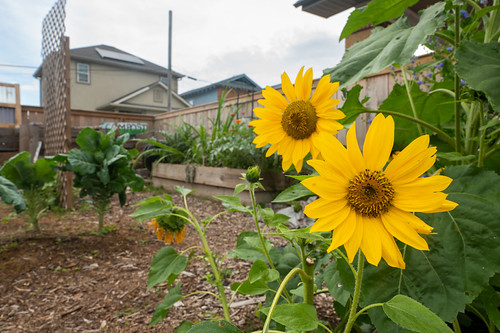
At Sankofa’s community garden in New Orleans, a compost sign points toward another part of the growing cycle • image by Kirsten Strough/USDA, April 29, 2023.
This week, we are looking beneath food gardens in the Southeast, especially sandy soils in South Carolina and Florida. A review published November 7, 2026, provides the newest research perspective. Because this week’s search yielded limited directly relevant original experiments, we also looked at an October 31, 2026 South Carolina orchard study. The practical recommendations come from the regional extension guidance; the orchard’s application rates are not a recipe for a backyard vegetable bed, but they do provide useful insights.
The November review, led by Qudrat Ullah in the “Journal of Soil Science and Plant Nutrition”, examines how organic amendments might support both soil carbon storage and suppression of soil-borne plant diseases. It draws on earlier research, with a stated search period of January 2000 through June 2025. The authors did not conduct a new field experiment or a new meta-analysis, but used data already gathered.
Their synthesis describes several possible mechanisms: microbes can compete with pathogens for resources, produce inhibitory substances, and help transform carbon into forms protected within soil. These are promising biological processes, but their performance depends on the amendment and its setting. The authors call for longer, multi-site studies measuring both outcomes together. For gardeners, the useful lesson is to be specific about the job: evidence for disease suppression in one soil does not make every bag of compost a disease treatment.
The South Carolina experiment, by Than Dam and colleagues in “Soil Science Society of America Journal”, provides a narrower test. At Clemson University’s Musser Fruit Research Center, researchers compared no compost with two compost application rates during peach-orchard establishment. They sampled the upper six inches of soil during 2020 and 2021, following pre-plant incorporation and subsequent spring applications.
Compost increased soil moisture, total carbon and nitrogen, and several indicators of biological nutrient cycling. Yet the step from no compost to the lower rate produced more consistent improvements than doubling that rate! Extractable inorganic nitrogen and phosphorus did not increase. This was already a fertilized orchard, and the authors call for deeper sampling, longer follow-up, and tree-performance measurements before identifying an optimum rate. The result supports measured use; it does not establish a vegetable-garden yield benefit. But here’s the thing, minimum composted material can be as effective as too much composted material.
For a gardener, those findings suggest separating two questions: “Am I improving the soil?” and “Am I meeting this crop’s nutritional needs?” They overlap, but they are not interchangeable. UF/IFAS explains that Florida’s sandy soils can lose mobile nutrients through heavy rain or excessive irrigation. Its vegetable-production guidance also warns that organic waste applications can contribute to water pollution when they exceed crop nutrient needs. Recycling a material does not eliminate the need to account for what it contains. UF/IFAS soil and fertilizer guidance
Start with a soil test, preferably before the next round of amendments. Clemson Extension recommends sampling areas with different management histories separately: the vegetable patch, lawn, and shrub border should not all be mixed into one bag. Tell the laboratory what you intend to grow, and follow its collection instructions. A useful report can help you decide whether phosphorus or lime is needed, instead of treating every tired-looking bed to the same ingredient. Clemson soil-testing guide.
There is an important wrinkle: Clemson’s routine recommendations do not rely on a measurement of available soil nitrogen, because that supply changes rapidly. Nitrogen guidance depends on the crop. A test is therefore a decision aid, not an inventory that stays accurate indefinitely. Keep the report beside your planting plan and record subsequent additions. The bag of fertilizer and the load of compost should appear in the same notebook, even if they arrived from different shops.
Next, find out what the compost was made from. Clemson’s soil-conditioning guide distinguishes yard-trimming compost, manure composts, and spent mushroom compost. They are not identical products. Manure and mushroom materials can contain substantial soluble salts; manure sources also warrant attention because herbicide residues may damage sensitive plants. Ask the supplier about ingredients, maturity, and available testing. A reassuringly earthy appearance does not guarantee the best chemistry. Clemson soil-conditioning guide.
If you make your own compost, give the pile time to finish. EPA guidance describes ready compost as dark, loose, crumbly, and earthy-smelling. Once it stops reheating after mixing and recognizable food scraps have disappeared, the agency recommends at least four weeks of curing. Screening can remove persistent sticks and other unfinished pieces. This is a useful place for patience: the seed packet may have a planting date, but the compost pile has never learned to read it. Having more than one compost pile started at different times can help with the scheduling of application. EPA home-composting guide.

In Florida, November can be an active planting month, so timing matters immediately. The UF/IFAS vegetable guide lists September through February for lettuce planting in central and south Florida. Its northern Florida schedule differs, and frost risk still deserves attention. Use the regional calendar for your crop rather than assuming that a national “fall gardening” checklist applies. Compost cannot compensate for planting a vegetable in conditions it does not tolerate. Florida Vegetable Gardening Guide. As local climates continue to mutate, gardeners may need to adjust their personal planting schedules.
Watering belongs in the same plan. That guide notes that irrigation needs depend on soil, rainfall, and crop age; sandy soils generally need more frequent irrigation than clay, muck, or amended soils. Organic matter and mulch can help conserve moisture, while vegetables still need drainage. After improving a bed, continue checking its condition rather than assuming the old watering routine remains suitable. Better soil management means paying attention to the combination of plant, soil, and weather.
Fertilizer timing also connects the vegetable patch with nearby waters. UF/IFAS advises gardeners to avoid fertilizing ahead of heavy rain and to keep fertilizer off hard surfaces where it can wash toward storm drains. Follow crop-specific recommendations and consider nutrients already supplied by irrigation with reclaimed water. These are small decisions, but they give conservation a practical place in the gardening calendar: the same afternoon spent feeding plants can include preventing nutrients from leaving the property. UF/IFAS fertilizer guidance.
An achievable next step is to make a one-page record for a single bed. Write down its area, intended crop, soil-test date, compost source, and the amount actually applied. Add irrigation changes and a few observations as the crop develops. This will not turn the garden into a controlled experiment, but it will replace “I think we added some last spring” with information worth taking to an extension agent.
The compost sign in that New Orleans garden points toward a satisfying habit: giving useful material another life. Thoughtful application completes the habit. Before reaching for another bag, ask what the bed needs, what this material supplies, and how you will know whether it helped. Those questions leave plenty of room for enthusiasm and may spare both your back and your garden an unnecessary second load.
Research references
– Ullah, Q., et al. “Organic Amendments for Simultaneous Soil Carbon Sequestration and Soil-Borne Pathogen Suppression: Mechanisms and Perspectives”.” – “Journal of Soil Science and Plant Nutrition”, November 7, 2026. Review; full text consulted.
– Dam, T., et al. “Short-term surface soil responses to compost rate during peach orchard establishment on sandy Ultisols](https://doi.org/10.1002/saj2.70392).” “Soil Science Society of America Journal”, first published October 31, 2026. Publisher’s abstract and plain-language summary consulted.
Comments
Compost: How Much Does Your Garden Need? — No Comments
HTML tags allowed in your comment: <a href="" title=""> <abbr title=""> <acronym title=""> <b> <blockquote cite=""> <cite> <code> <del datetime=""> <em> <i> <q cite=""> <s> <strike> <strong>